
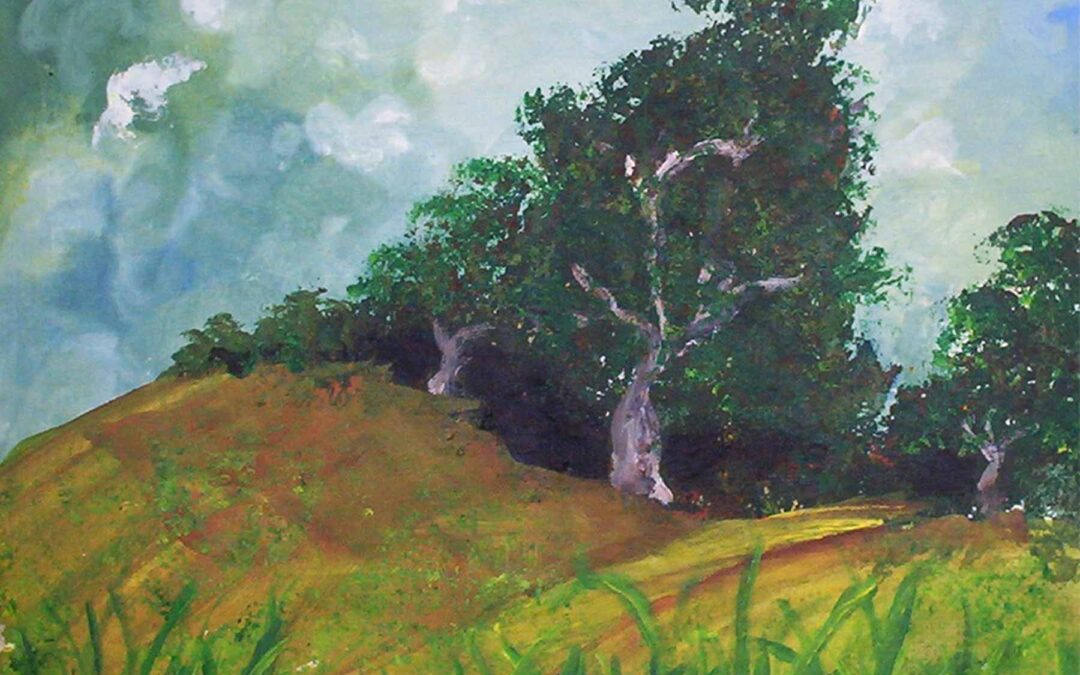
The challenge of landscape painting is like a dance with the elements themselves. How do you capture the fickle play of light across a rippling pond? How do you convey the majesty of a slow-moving stream over a scatter of oddly misshapen rocks, or the warmth of a sunset peeking through a patch of trees. Every brushstroke is a question, every color choice a decision that can lead to a moment of pure artistic triumph or a lesson in humility.
Yet, landscapes are by far one of my most favorite things to paint. I love working with the many hues of green and the brightly hued colors of a fall scene.
For me, there is a landscape to suit every mood and every artistic inclination. It’s a genre that’s as broad as the horizon and as deep as the human imagination.
But what I love most about painting landscapes is the way it invites me to slow down, to really see the world around me. In a world where everything is rushing by at breakneck speed, where we’re bombarded by the digital and the artificial, there’s something profoundly grounding about taking the time to study a scene, to understand its contours, its atmosphere, and to render it with my own two hands. It’s a form of meditation, a way to find peace and balance while creating something beautiful and translating that beauty into a form that others can share. It’s a chance to express my emotions, to tell a story without words, and to leave a little piece of myself in the world.
When someone looks at my painting and feels a spark of recognition, a moment of connection with a place they’ve never been or a time long past, that’s when I know I’ve truly captured the magic of the landscape. It’s a reminder that we’re all part of the same grand tapestry, woven together by the threads of nature’s beauty.
It’s a way to whisper to the universe, “I see you, and you are breathtaking.”